
Quick answer
Commercial plumbing in Gauteng must meet applicable National Building Regulations and the relevant municipality’s water and sanitation by-laws. Standards such as SANS 10400, SANS 10252 and SANS 10254 provide requirements or recognised compliance routes for specific systems; the applicable provisions depend on the building, installation and scope of work. A plumbing Certificate of Compliance (COC) documents the work within its scope but does not replace municipal approval or certify an entire building automatically.
When a commercial building needs a plumbing compliance check
Arrange a plumbing assessment before fitting out a shop, converting offices into a restaurant, adding toilets or replacing a hot-water installation. A change in occupancy or use can affect fixture numbers, water demand and drainage capacity, even when the existing pipes appear serviceable.
Recurring blockages, sewer smells, leaking geysers and unexplained water use also justify investigation. These symptoms do not prove a code breach, but repairing the immediate fault without checking its cause can leave an unsuitable installation in service.
- Check that added basins, sinks and toilets connect to suitable drainage with appropriate traps and ventilation.
- Review backflow protection where drinking-water pipes serve equipment, irrigation or alternative water systems.
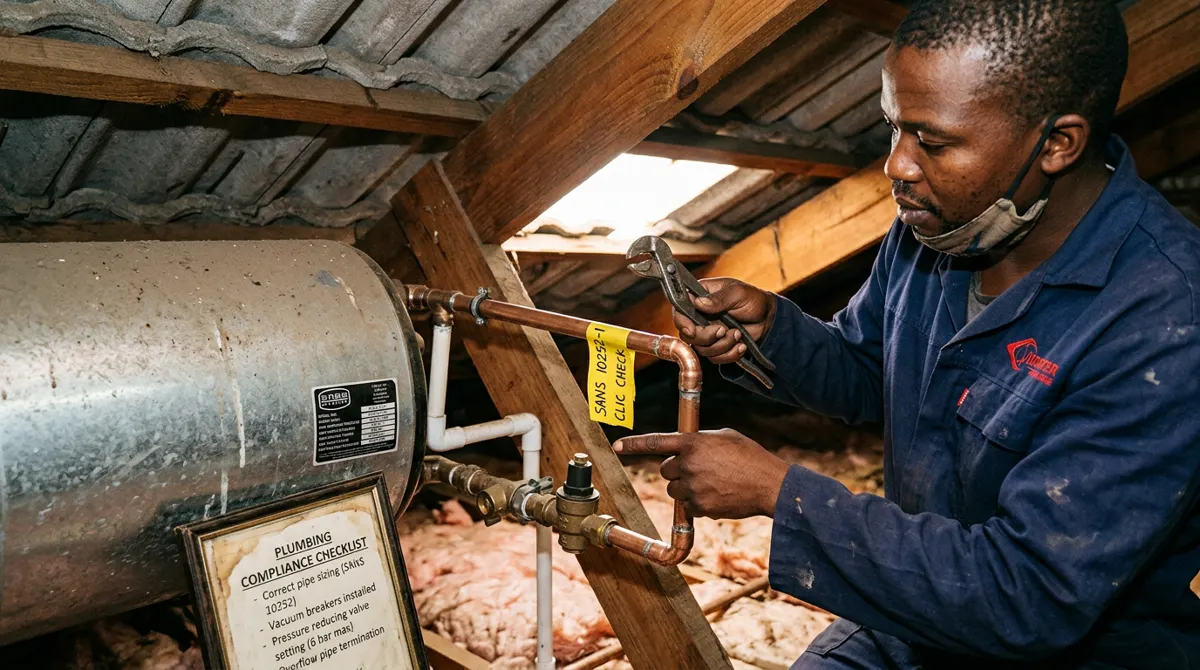
- Investigate safety-valve discharge pipes that are blocked, capped or routed where hot discharge could injure someone.
- Compare the installation with approved drawings and records before taking over altered premises.
Which standards apply, and what affects compliance costs?
The National Building Regulations and Building Standards Act provides the national legal framework. SANS 10400 gives recognised deemed-to-satisfy routes for meeting the regulations, including Part P for drainage and Part W for fire installations. SANS 10252-1 addresses water supply installations in buildings, while SANS 10252-2 addresses drainage installations. SANS 10254 covers fixed electric storage water-heating systems, rather than every type of commercial hot-water plant.
A standard is not automatically a blanket legal requirement simply because it exists. Its application can arise through regulations, municipal by-laws, approval conditions or contracts. Confirm the applicable editions and requirements for the proposed work; complex systems may need a competent professional’s design rather than a straightforward repair.
- Scope: a local repair differs from redesigning an undersized supply or drainage network.
- Access: concealed pipework, ceiling access and occupied premises affect the work involved.
- System condition: existing pipe materials, isolation valves and previous alterations may influence remedial work.
- Technical requirements: backflow protection, hot-water safety, grease separation and specialist design can add to the scope.
- Administration and testing: drawings, municipal submissions, inspections and commissioning requirements affect the overall job.
Gauteng municipal requirements and practical checks
Gauteng does not have one municipal plumbing rulebook. A property in Benoni falls within Ekurhuleni, while properties in Johannesburg or Tshwane must be checked against their respective municipal requirements. Before altering connections, drainage layouts or a building’s use, establish which plans, permissions and inspections the local authority requires.
Commercial activities bring additional considerations. A food business may need approved grease-management arrangements; a workshop’s effluent may require municipal consent and treatment before discharge. Borehole, rainwater and municipal supplies must be arranged to prevent contamination of drinking water. Fire-water systems also need separate attention: do not alter them as though they were ordinary domestic supply pipes.
- Keep stormwater and foul drainage separate; do not connect roof runoff to the sewer.
- Confirm fixture provision and accessibility requirements for the intended occupancy.
- Maintain access to isolation valves, inspection points and equipment needing servicing.
- Keep approved drawings, test results, maintenance records and applicable COCs together.
- Check landlord or body corporate permission separately from municipal approval.
Discuss your commercial plumbing work with Fox Plumbing
Fox Plumbing is based in Benoni and serves the East Rand and greater Gauteng. Owner Evan Pretorius is a qualified registered plumber with more than 20 years’ experience, is a member of IOPSA and PIRB, and remains on the tools. Fox Plumbing issues COCs; agree which work the certificate will cover before the job begins.
The price is agreed upfront, the call-out fee includes the first hour of work, and every job is insured. Phone 084 368 1879 to discuss the premises, the proposed changes and any existing plans or notices. Hours are Monday to Friday, 08:00–17:00, with Saturday appointments by arrangement.
- Provide the property address so the relevant municipality can be identified.
- Explain the building’s current use and any planned change of use.
- Have previous COCs, approved plans and fault details available.
- Clarify any required specialist design, municipal approval and certification before work starts.
How we do the job
- 1
Define the work and building use
Record whether the job is a repair, replacement, extension or change of use. Identify the fixtures, equipment and tenant areas affected.
- 2
Inspect the existing installation
Check accessible water supply, drainage, isolation points, hot-water safety and relevant records. Identify defects and any areas that need further investigation.
- 3
Confirm requirements and approvals
Establish the applicable standards and municipal requirements. Arrange any necessary design, submissions or permissions before starting work that depends on them.
- 4
Agree the scope and shutdown arrangements
Set out the corrective work, price, exclusions and documentation to be supplied. Plan water interruptions with tenants and protect access to essential facilities.
- 5
Install, test and inspect
Complete the agreed work using suitable components. Carry out the relevant pressure, leakage, flow and drainage checks, and arrange required inspections before concealing work.
- 6
Hand over the records
Provide applicable certification and test records, explain maintenance needs and identify outstanding work. Keep the documents with the building’s plumbing records.
Common questions
Is a PIRB COC the same as municipal approval? +
No. A PIRB COC records compliance for the plumbing work described on it. Municipal plan approval, inspections and other building requirements are separate processes where applicable.
Does every small plumbing repair need new building plans? +
Not necessarily. A like-for-like repair and a new drainage layout are different scopes of work. Check with the relevant municipality when altering layouts, connections or building use rather than assuming all repairs need approval—or that none do.
Must all older commercial plumbing be replaced? +
Age alone does not establish that replacement is necessary. Assess its condition, safety, capacity and applicable requirements. Unsafe work, unauthorised alterations or a proposed change of use may require corrections.
Does SANS 10254 cover every commercial water heater? +
No. It addresses fixed electric storage water-heating systems. Boilers, heat pumps, solar systems and other plant may involve additional or different standards and design requirements.
Can a COC cover plumbing that was not inspected or worked on? +
Do not assume it does. Read the certificate’s description and scope, and ask the issuing plumber what was assessed and certified. A certificate for a geyser replacement is not automatically confirmation that every drain and water pipe in the premises complies.